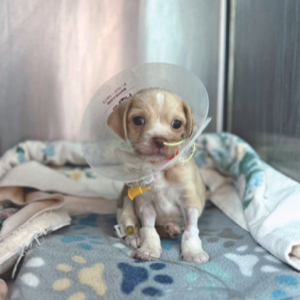
A dog wandering around Boston by itself is unsettling, but a sick puppy is even worse.
Fortunately, Boston Animal Control was able to catch the stray Chihuahua-mix pup and prevent further harm to it. However, Animal Control quickly realized the dog had symptoms of a highly contagious viral disease called parvovirus. A puppy can die within 48 hours after exhibiting symptoms of the virus, so when the puppy tested positive, the MSPCA-Angell was notified. “We have a long-standing partnership with Animal Control, but since they are a municipal shelter, they don't have the same facilities or staff as we do," said Mike Keiley, Director of Adoption Centers and Programs at the MSPCA-Angell. "We took the pup into our care to support what Animal Control already began."
According to Dr. Ariel Fleischman of the MSPCA-Angell's Emergency and Critical Care (ECC) service, the puppy was about six weeks old. “He arrived in a cardboard pet carrier, and he was so small — he weighed half a pound — that he was totally buried in the blankets. I had to sift through to find him.”
The puppy, named Tuesday by the Angell staff, immediately began parvovirus treatment, which included antibiotics and fluids. According to Dr. Fleischman, parvovirus attacks cells that are rapidly dividing. “The gastrointestinal tract is hit the worst, which is why we see the vomiting and diarrhea — and then the severe dehydration,” she said. Parvovirus also attacks the bone marrow, which in puppies like Tuesday, is rapidly dividing, resulting in a dramatic drop in white blood cells. “When this happens, we get concerned of life-threatening secondary infections because puppies don't have the immune system at that age to fight off impending threats,” explained Dr. Fleischman.
Other symptoms of parvovirus include lethargy and vomiting, which can lead to anorexia. Infected dogs and contaminated objects can spread the highly contagious virus. A puppy's risk of contracting the virus increases whenever he sniffs, licks, or consumes infected feces. “Parvovirus is always fatal without treatment and can be avoided altogether with vaccination,” explained Dr. Fleischman. Puppies should receive the canine parvovirus vaccine around the first six weeks of age. “And owners should be sure that their dog's parvovirus vaccination is up-to-date every three years,” she added.
In two days under the care of Angell's ECC doctors, Tuesday was wagging his tail, an indication that he was feeling better. “Once he was at a point where he was stable enough to leave 24-hour care, we transferred him to the shelter's clinic — in an isolation space — and then ultimately put him into foster care with one of our foster families,” said Keiley. Tuesday's story had already hit social media, and plenty of potential adopters were ready to take the puppy home.
Keiley attributes Tuesday's success and the success of other animals in need to donor support and the strong partnership between the MSPCA-Angell and Boston Animal Control. “Our relationship shows how the layering of support in the Boston communities really helps to not only prevent disease but also take care of the animals that do get sick,” he said. “Our goal is to provide affordable care that helps keep pets and families together. And by combining forces, we're able to offer this care to our communities.”
Tuesday fully recovered from parvovirus, and was soon adopted by his new family.