-
Adopt
-
Veterinary Care
Services
Client Information
- What to Expect – Angell Boston
- Client Rights and Responsibilities
- Payments / Financial Assistance
- Pharmacy
- Client Policies
- Our Doctors
- Grief Support / Counseling
- Directions and Parking
- Helpful “How-to” Pet Care
Online Payments
Emergency: Boston
Emergency: Waltham
Poison Control Hotline
-
Programs & Resources
- Careers
-
Donate Now
Enrichment involves introduction of one or more factors to an environment that improves the physical and psychological welfare of an animal. These factors frequently refer to physical, social, and husbandry interventions that improve the behavioral environment of animals that live with us, allowing them to practice species-typical behaviors. Mental enrichment is particularly important as it allows animals to utilize a variety of senses to solve problems reducing boredom, stress, and anxiety.
A cat’s comfort level with its environment is directly linked to physical and emotional health. As such, it is critical that we meet a cat’s environmental needs making environmental enrichment a necessary step for feline wellbeing.
Five Pillars
1 – Provide a safe place
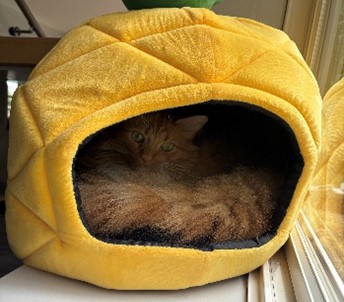
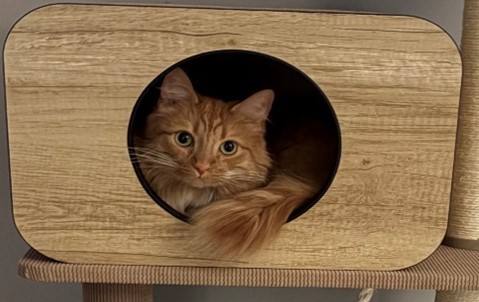
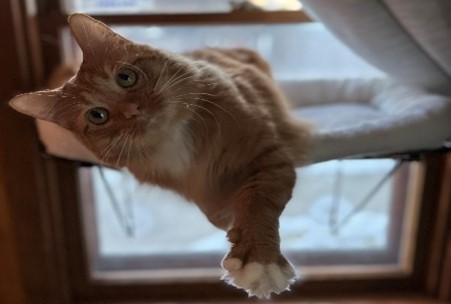
Cat’s need private and secure places to hide, often in a raised location. To do this, provide plenty of options including perches, shelves, cat trees, cat hammocks, cave beds, and even their carrier.
 |
 |
 |
2 – Provide multiple and separated key environmental resources
Cats are naturally solitary, territorial animals. As such, resources such as food, water, litter boxes, scratching areas, resting areas, and play areas should be physically separated to avoid stress associated with competition (from other cats or other potential threats – dogs, humans). Cats should also have a choice for each resource. To do this, utilize the “n+1” rule, meaning 2 cats = 3 litter boxes, etc.
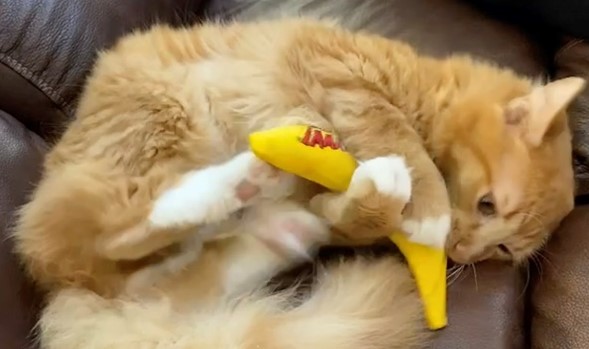
3 – Provide opportunity for play and predatory behavior
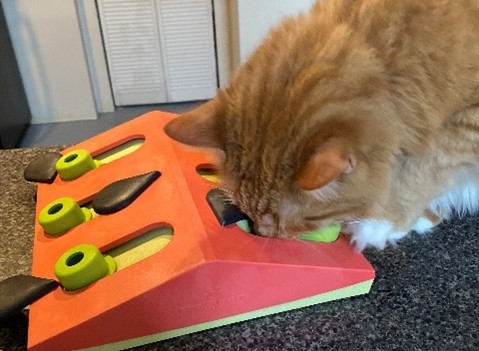
In the wild, cats are solitary predators that consume small prey often. In order to mimic their natural instincts and allow them to perform normal behaviors such as hunting and foraging, it is best to feed cats frequent small meals throughout the day using a variety of puzzle feeders. Cat should be fed separately from other cats and preferably in an elevated space, if physical health allows, to provide a sense of safety.
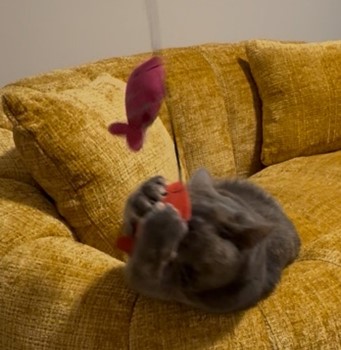
It is also important to provide opportunities for play by providing toys and opportunities for play-based interaction with humans and socially compatible cats.
 |
 |
 |
4 – Provide positive, consistent and predictable human-cat social interaction
Social preferences vary among cats, but most cats tend to prefer frequent, low intensity social contact with humans. Allow the cat to initiate, choose, and control the type of interaction as each cat has an individual preference for preferred contact (petting, grooming, picked up, cuddling, etc). Look for signs of relaxation and willingness to interact with people such as slow blinking, purring, head bunting, and facial or body rubbing against a person.
5 – Provide an environment that respects the importance of a cat’s sense of smell
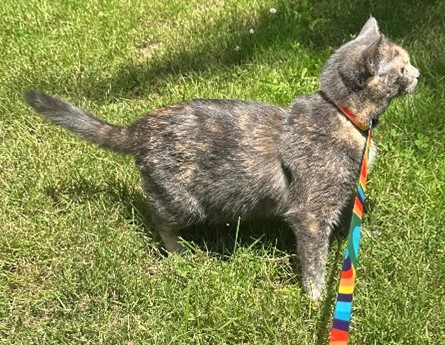
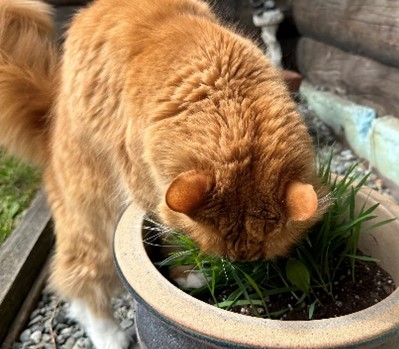
It is critical to give cats enrichment options that utilize their senses. Specifically, cats use olfactory information to evaluate their surroundings and maximize their sense of security. Allow cats to scent mark their environment through scratching posts and facial rubbing and avoid covering up their scent with strong cleaners, detergents, or scented litters. Pheromones can help to enhance the feeling of comfort in their home. Furthermore, encourage cats to utilize their sense of smell by hiding treats or their favorite toys to find or providing controlled outdoor exposure like catios or harness training. Other great olfactory options are catnip, silvervine, and cat grass.
 |
 |
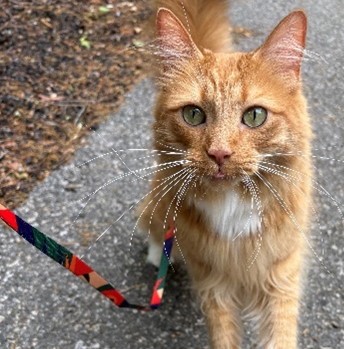 |
All photos provided courtesy of Bridgette Wilson
Training
Training your cat is an excellent way to provide enrichment, strengthen the human-animal bond, and decrease stress. By rewarding them with their favorite treats, you can teach them to come when called, sit, walk on a leash, lie on a mat, even to jump over a dowel placed over two soup cans (cat agility). Kitten Kindergarten is an additional way to help kittens under the age of 15 weeks learn to be confident and social. If you are interested in scheduling a training session with one of our trainers, you can do so here.
References
Dantas LMS, Delgado MM, Johnson I, et al. Food puzzles for cats: feeding for physical and emotional wellbeing. J Feline Med Surg 2016; 18: 723 –732
Ellis, SLH. Environmental Enrichment: Practical Strategies for Improving Feline Welfare. J Feline Med Surg 2009; 11: 901-912.
Ellis, SLH, et al. AAFP and ISFM Feline Environmental Needs Guidelines. J Feline Med Surg 2013; 15, 2019-230
Sadek, T, et al. Feline Feeding Programs: Addressing behavioral needs to improve feline health and wellbeing. J Feline Med Surg 2018; 20: 1049-1055


